
welcome

Chenise Sinclaire is dedicated to empowering survivors of narcissistic abuse through insightful content, real-time support, and transformative guidance.
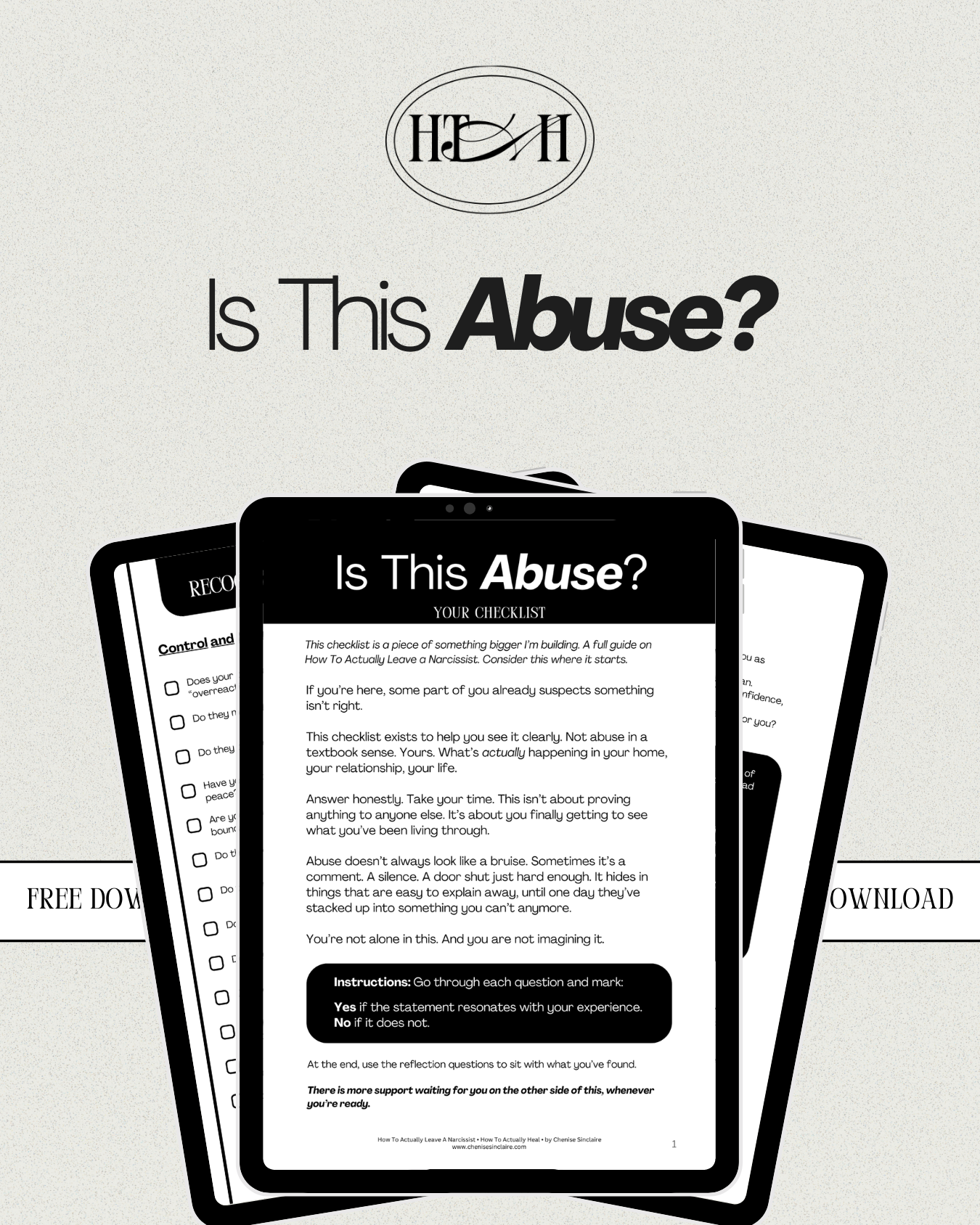
This is the checklist that’s already been downloaded into over 750+ inboxes around the globe. Now it’s bigger, sharper, and impossible to skim past.
You’re not here by accident.
Something happened. Or nothing happened, and that’s exactly the problem. You’ve been turning it over for weeks, months, maybe longer, and you still can’t say it out loud without someone telling you you’re reading into it. So you searched instead. At 1am, on your phone, in the one room in the house where nobody’s watching.
This is what you were looking for.
Version 2.0 is love. What started with 60 questions is now 139, across ten fully rebuilt categories, including Narcissistic Traits, which was buried in the original under the wrong heading and never had it’s own name until now. This isn’t a light update. This new version leaves nothing out and asks clearer questions.
This checklist is a direct extract from Module One: Understanding Your Situation and Narcissistic Abuse inside the How To Actually Leave a Narcissist Guide.
Specifically, this comes from Week One, where you begin to understand what you’ve been experiencing, not just emotionally but psychologically.
What you’re reading here is the foundation of the work.
You can feel it. Something isn’t quite right. But every time you try to explain it, it gets minimised, twisted, or turned back onto you. So you start questioning yourself again instead.
This checklist was created for that exact moment.
You don’t have time to read a 100-page book right now. You need to know, tonight, whether what you’re feeling has a name.
Inside, you’ll be guided through a series of simple but confronting questions that help you gently uncover patterns of control, manipulation, emotional abuse, and confusion that are often designed to keep you stuck.
Because narcissistic abuse doesn’t always look like what you think it should or what we have been stereotypically taught.
It looks like:
second guessing yourself.
walking on eggshells.
missing the ‘good version’ of them.
feeling drained but not knowing why.
This is a piece of clarity for you - not a diagnostic for them.
A private safe space for you to see your reality written out in front of you without interruption, without being dismissed, and without someone telling you that you’re ‘overreacting’.
At the end, you’ll also be guided through reflection prompts to help you process what you’ve uncovered and begin reconnecting with your own voice again.
If even one question makes your chest tighten, that matters. You’re not imagining it, and you’re not alone.
You don’t need to have all the answers yet. You don’t even need to be ready to leave. Just start here. This is where everything begins.
Most ardently,
Chenise Sinclaire.
You already know something is wrong.
You've known it at 2am, lying awake running the same conversation through your head again. You've known it in your stomach; that drop when you hear their car pull in. You've known it in the way you feel lighter, freer, more like yourself when they're not around.
And then you've talked yourself out of it. Again.
“But he's so good to me most of the time. It's not like he hits me. Maybe I am too sensitive. People have it so much worse.”
Here's what I need you to understand: those thoughts are not evidence that nothing is wrong. They are evidence that you have been systematically taught not to trust yourself.
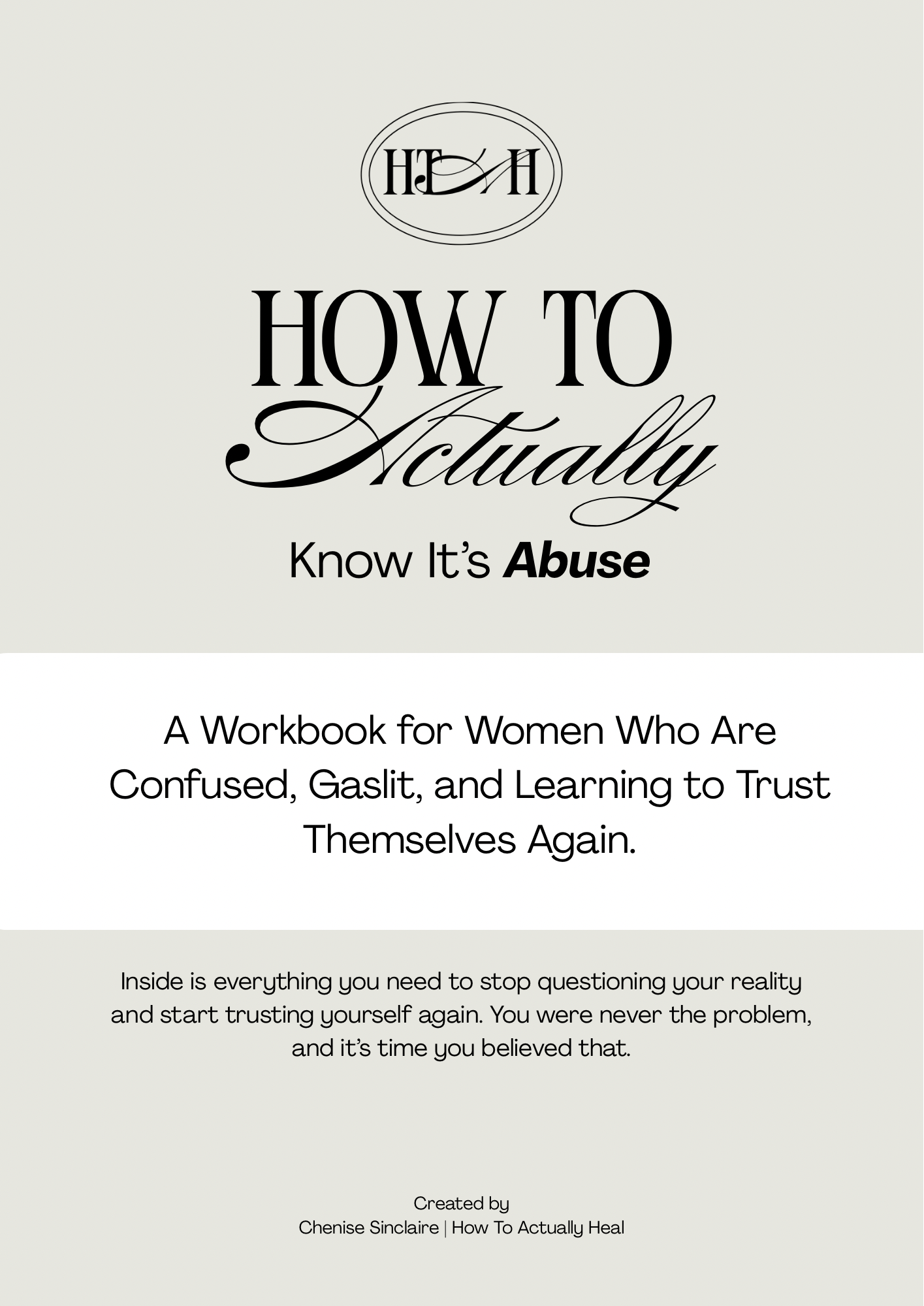
This workbook is for the part of you that is tired of arguing with herself.
What's Inside
A Letter To You Before we do anything else, we slow down. You'll be met exactly where you are: confused, exhausted, maybe still hoping you're wrong. No rushing. No pressure. Just finally feeling understood.
Why You're Confused & Why That Makes Perfect Sense You'll learn about the cycle of abuse, the minimisation ladder, and why the fog you're living in is one of the most reliable signs that something is genuinely wrong.
The Body Knows Your mind can be convinced. Your body cannot lie. This section includes a physical symptoms checklist and a guided body scan exercise that helps you reconnect with the part of you that has been keeping score this whole time.
Naming What Happened & The Behaviours Explained Gaslighting. Emotional withholding. Control and isolation. Verbal degradation. Threats and intimidation. Emotional manipulation. Each one explained in plain language, with real-life examples that sound exactly like things you've actually heard and reflective prompts to help you stop minimising what happened to you.
The Gaslight Gallery A two-column table showing the exact phrases used in these dynamics and what they were actually doing underneath the words. When you see "You're too sensitive" translated into what it was really communicating, something shifts. You'll want to read this section twice.
Love Is Not Supposed To Hurt Like This A side-by-side comparison of what healthy love actually looks like versus what you've been living with. Plus a Fantasy vs. Reality exercise that gently separates the person you fell in love with from the person who has been causing you harm. Both things can be true. This section helps you hold that without falling apart.
Listening To Yourself Again This is the section that changes things. You'll learn to tell the difference between the voice that was installed in you (the one that doubts, minimises, and apologises) and your actual voice. The one that has been there the whole time, waiting. Daily trust-building practices and a letter-to-yourself prompt are included.
What Now? Your Next Steps Without Pressure No one here is going to tell you what to do. What you'll get instead is clear, honest information about your options including an important note on why couples counselling can actually make things worse in these dynamics, and where to find support when you're ready.
This Is Not Another Checklist
There are hundreds of abuse checklists online. You've probably read most of them, decided your situation didn't quite fit, and closed the tab.
This is not that.
This is 28 pages of the most honest, specific, compassionate writing I know how to do, designed for the exact experience of being a woman who knows something is wrong but cannot yet find the words, the proof, or the permission to trust herself.
The permission is in here.
It was always yours. This workbook just helps you find it again.
*28 pages. Instant download. Work through it in order or go straight to the section that's calling you. Bring a pen. Take breaks. Be gentle with yourself because you are doing brave and important work.*
*This workbook is a support tool, not a substitute for professional help.*
You don't have to figure this out one confusing Google search at a time.
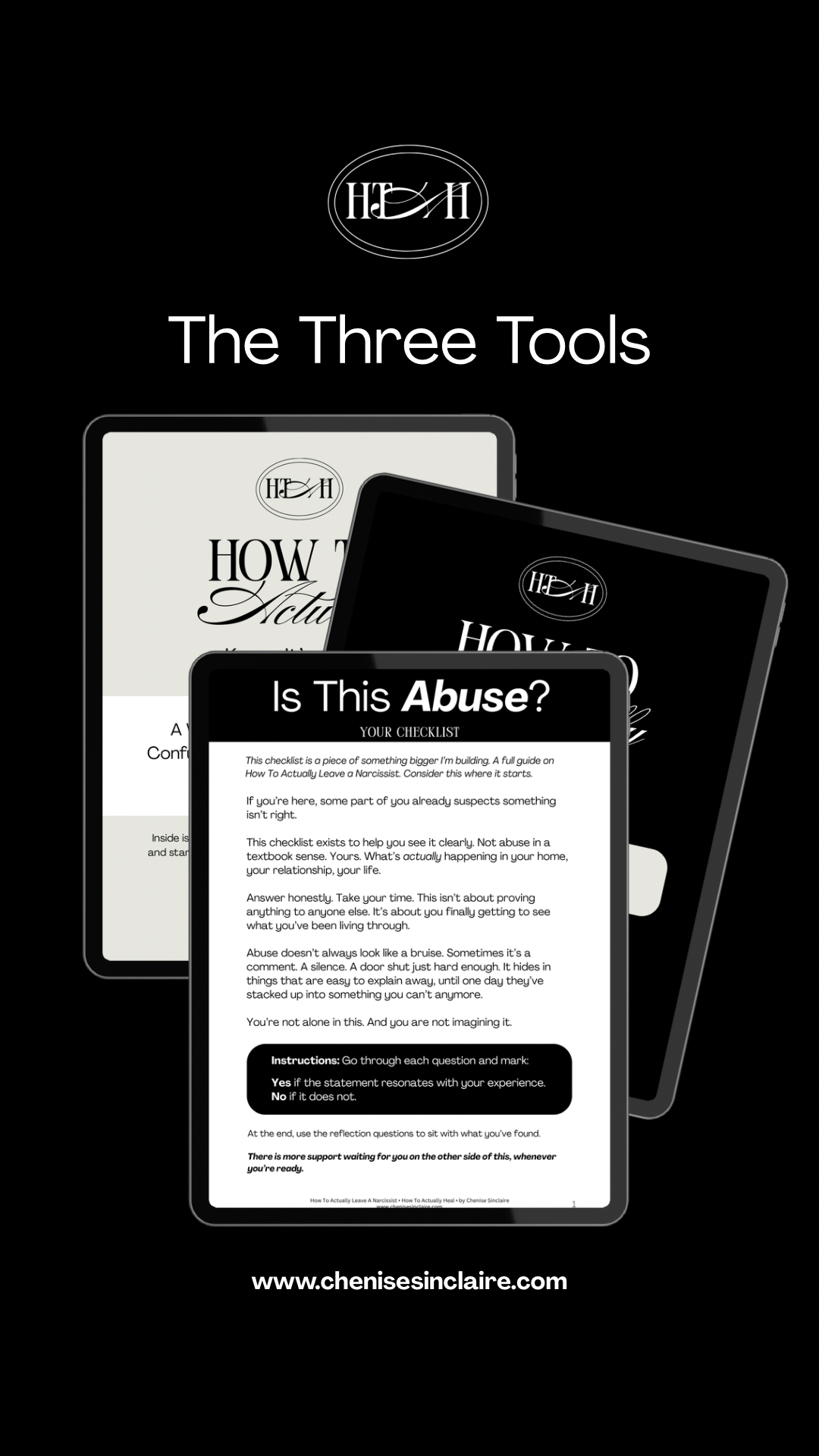
This bundle is the entire process, in order. Everything I built to get you from "is this even abuse" to actually knowing, actually documenting, and actually understanding what happened to you.
What's inside:
Is This Abuse? The Checklist — 139 questions across 10 categories. This is where you stop guessing and start seeing the pattern for what it is.
How To Actually Document Abuse — a 16 page incident log with space for 8 entries, a pattern tracker, and a ready-to-use summary page if you ever need to hand this to a lawyer or advocate. Your memory shouldn't be the only evidence you have.
How To Actually Know It's Abuse — the full workbook. This is where you go deeper than the checklist, put language to what happened, and start to understand why none of it was your fault.
Why bundle it
These three were always meant to be used together. The checklist helps you name it. The log helps you prove it. The workbook helps you understand it. Buying them as one means you're not starting from zero three separate times, and you're saving against buying the log and workbook on their own.
The details
Instant digital download. You'll receive one zip file containing all three PDFs. Everything is designed to be printed, filled in digitally, or both. Your answers and entries are yours alone. Nothing is shared, tracked, or submitted anywhere.
$88.95 AUD
If you're not ready for all three yet, start with the free checklist. When you're ready for the rest, it's here.

You’ve lived it and you know what happened.
But when it’s time to talk to a lawyer, file a report, or face a courtroom, the story you have been carrying in your head needs somewhere they can actually use it.
This is that place.
The How To Actually Document Abuse | Incident Log is a professional-grade template designed specifically for women leaving abusive relationships. It takes everything you’ve been trying to hold onto (the dates, the details, the moments you were afraid no one would believe) and puts it into a format that lawyers, advocates, and judges understand.
No legal background needed. No knowing where to start. Just open it, and begin.
Inside The Template, You Will Find:
A clear disclaimer and terms of use page, so you know exactly what this document is (and isn't) before you begin.
A safety resource page with emergency and 24/7 support contact information, front and centre, before anything else.
A personal information page to anchor your record.
A fully worked example entry, so you can see exactly what a strong entry looks like before you write your own.
10 individual incident entry pages, ready to fill in, no duplicating or formatting required.
A pattern tracker to map what happened across time.
A full abuse type reference guide so you can name exactly what occurred. (Pairs well with the free "Is This Abuse?" checklist, same 10 categories, same language.)
A one-page summary built specifically to hand to a lawyer or advocate, so they understand your situation without reading the whole log.
Evidence and safety tips, including how to store your documents somewhere they can't find them.
This is for you if:
You just left (or you’re in the middle of leaving) and you know documentation matters but you don’t know the form it should take.
You’ve been writing things down but it reads like a story, not a legal record.
You want something that will actually hold up if it ever needs to.
What you experienced was real. This template helps make sure the right people know it too.
Instant download. Yours to keep forever, fill in, and share with whoever is in your corner.
Each platform offers a unique experience; choose the one that speaks to you, or explore them all.
How To Actually Leave A Narcissist | Official Course
A 13 week step-by-step guide to safely leaving, healing, and reclaiming your life after narcissistic abuse. This course provides the tools, strategies, and mindset shifts needed to break free, set boundaries, and step into your highest self.
(BONUS 4 WEEKS POST ESCAPE)

Water-Shed | An Open Journal
A raw and unfiltered space where Chenise Sinclaire documents the journey of healing, self-reclamation, and transformation after narcissistic abuse. Through personal reflections and deep insights, Water-Shed offers validation, perspective, and connection for those ready to heal.

How To Actually Heal | YouTube
A destination for healing, self-improvement, and personal growth after narcissistic abuse.
Chenise Sinclaire shares in-depth videos on rebuilding confidence, setting boundaries, and stepping into your highest self.

TikTok | @CheniseSinclaire
With over 66,700 followers, a dedicated 80% female audience, and 1.6 million likes, Chenise Sinclaire’s TikTok is a powerful space for survivors of narcissistic abuse to find validation, healing, and transformation. Her short form content resonates deeply, with her viral birth-time story reaching 3 million views, sparking important conversations about covert abuse and self-reclamation.

Threads | @CheniseSinclaire
Follow Chenise Sinclaire on Threads for bite-sized reflections, bold observations, and raw insights about narcissistic abuse, motherhood, and becoming your highest self. This is where you’ll find the moments that didn’t make it to the podcast; truth bombs, inner power, and a touch of humour.

How To Actually Heal | Podcast
Healing and self-growth - on the go. The How To Actually Heal podcast brings Chenise Sinclaire’s empowering YouTube content to an audio format, so you can listen anytime, anywhere. Tune in for deep insights on rebuilding after narcissistic abuse, reclaiming your power, and creating the life you deserve.

Instagram | @CheniseSinclaire
A space for healing, empowerment, and daily inspiration. With 4,000+ followers and an 83% women audience, Chenise Sinclaire’s Instagram is a blend of relatable memes, powerful quotes, and elegant visuals that reflect both resilience and refinement. Through daily posts, she shares personal insights, self-growth wisdom, and a touch of style; creating a community where survivors feel seen, supported, and inspired to step into their highest selves.

I DIDN’T GO THROUGH ALL OF THAT FOR NOTHING
“One day you will tell your story and it will be someone else’s survival guide.”